
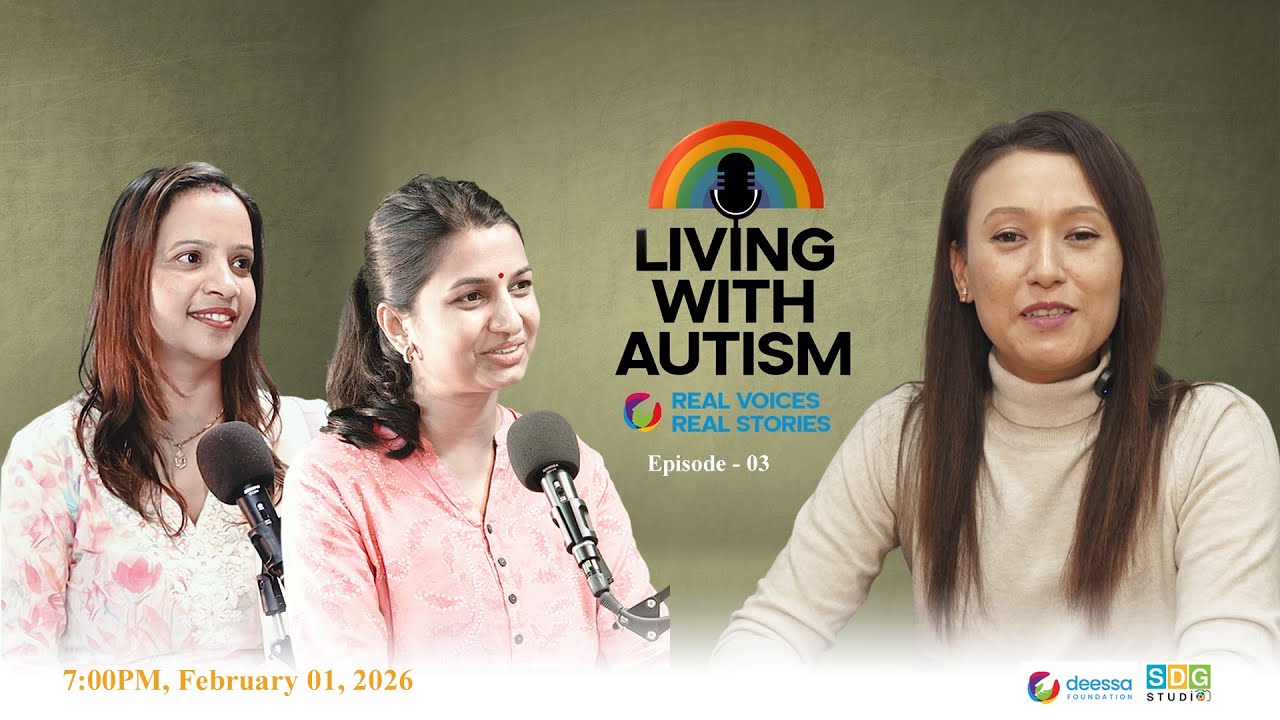
Living with Autism: Real Voices, Real Stories || EP 3 ll deessa Foundation
Episode 3 • 26
Living with Autism: Real Voices, Real Stories || EP 3 ll deessa Foundation
Featuring Ms. Kripa Shrestha•Duration: 26
Key Topics & Timestamps
Discovery and enrollment in the Parent Child Training Program (PCTP)
The value of community and sharing experiences with other parents
Practical teaching strategies using visual aids (e.g., brushing teeth)
Importance of routine and schedules in behavior management
Real-life application: A success story on toilet training
Kripa Shrestha's "France vs. Japan" analogy for the autism journey
Empowering parents as the child's primary teacher and advocate
Breakdown of the two-month training curriculum and theory classes
Creating Individualized Education Plans (IEP) based on assessments
Developing communication skills to reduce behavioral issues
Description
This video is the third episode of the podcast series "Living with Autism: Real Voices, Real Stories," produced by the deessa Foundation with technical support from SDG Studio. The episode focuses on the Parent Child Training Program (PCTP), a crucial initiative for parents of children with autism. Hosted by Merina and Sarita, the episode features a special guest, Ms. Kripa Shrestha, a senior trainer from the Autism Care Nepal Society. The discussion centers on why parents need specialized training to understand and support their neurodivergent children. Kripa Shrestha shares her personal journey as a mother of an autistic child and her professional expertise, explaining how the training empowers parents, reduces stress, and teaches practical strategies like structure, routine, and communication tools (e.g., PECS).


Show Notes
Note 1
The "Holland" Analogy: The guest uses the famous "Welcome to Holland" analogy to describe the unexpected journey of raising a child with autism—you planned for France (a typical child) but landed in Japan (a child with autism). It’s not a bad place, just different, and you need to learn the language and culture.
Note 2
Behavior as Communication: The training helps parents decode why a child acts a certain way (e.g., sensory issues, lack of communication skills) rather than just seeing it as "naughtiness."
Note 3
Parent as the First Teacher: Professionals (therapists) spend limited time with the child. Parents are the constant presence; thus, empowering them to continue therapy at home is vital.
Full Transcript
Full Transcript
- Introduction: Hosts Merina and Sarita introduce the show "Living with Autism" and the topic of the day: Parent Child Training Program (PCTP).
- A Parent's Realization: Merina shares how she didn't know about PCTP initially. After enrolling, she realized therapy alone wasn't enough; she needed to understand how to teach her child at home.
- The Wait & Anticipation: Discussing the high demand for training in Nepal (waiting 4-5 months). The initial hope that the training would "cure" autism, followed by the realization that it’s about management and understanding.
- Practical Techniques: Discussion on specific techniques learned, such as breaking down tasks (e.g., brushing teeth) using pictures (PECS) and the importance of visual schedules.
- Consistency: Why children behave well with therapists but not at home. The key is consistency in instructions between the therapist and the parent.
- Guest Segment (Kripa Shrestha): Kripa Ma'am introduces herself and shares the "France vs. Japan" travel analogy to explain the parenting journey.
- Parents as Translators: She describes parents as "Translators" and "Protectors" for their children. To do this role well, they must learn the "language" of autism.
- Training Details: Kripa explains the 2-month course: 1 week of theory, followed by functional assessments (communication, motor skills, imitation) to create an Individualized Education Plan (IEP).
- Message of Hope: Kripa emphasizes that while every child learns at their own pace, every child can learn. The training builds the parent's confidence to be the best advocate for their child.
- Conclusion: The hosts wrap up by agreeing that PCTP gives "Hope" and "Confidence," transforming the mindset from "my child can't" to "my child learns differently."
Have a story that needs to be heard?
We are always looking for new voices and perspectives from the community. Suggest a topic or share your personal journey with us.